

From Landmarks to Lumber
Two giant redwoods guided sailing vessels past a sunken hazard. Then they disappeared into some lumberman’s pile of planks.

Back in the colonial day, hidden danger lurked in San Francisco Bay. A massive rock west of Yerba Buena Island lay only six feet below the surface at low tide, just deep enough that a navigator couldn’t make the obstacle out. And since the water on the rock’s sheer sides fell off sharply to some 45 feet, tossing a lead line to mark depth gave no warning of the obstacle. All too often the rock announced its presence with the ominous shudder of wood grinding into stone, shattering, and letting the cold, dark water in.
After any number of such shipwrecks, navigators figured out a way to tell where the rock lay. By lining up Yerba Buena’s north end with the crowns of two immense redwoods at the south end of a grove topping the hills in what is now Oakland, they could pinpoint the rock’s location then steer away and around.
This navigational shortcut was recorded by Captain F. W. Beechey of the British Royal Navy, who entered the bay in 1826 while touring the Pacific and named the rock after his ship, the HMS Blossom. The hazard became Blossom Rock, and the trees the Blossom Rock Trees.
They must have been enormous. The redwoods lay 16 crow-fly miles from Blossom Rock, yet Beechey described them as “too conspicuous to be overlooked.” In those days old-growth groves in the Oakland hills featured trees up to 300 feet tall and 30 feet across. The Blossom Hill Trees had to be that massive to stand tall at such a distance.
From Spanish and Mexican colonial times into the American occupation beginning in 1848, the trees guided ship after ship past Blossom Rock. In 1854 the erection of the first Alcatraz lighthouse rendered them passé. Soon they met the fate of almost all the rest of Oakland’s old-growth redwoods: felled by ax and saw, bucked into logs, hauled away by oxen, and milled into lumber.
San Francisco was a gold rush boomtown, a mushrooms-after-the-rain urban explosion from the waterfront up into the hills. All that building required millions upon millions of board feet of lumber for every purpose wood could be put to. The big redwoods across the bay offered a close-by source. And the lumber they yielded was as nearly perfect as anything that grows on earth: resistant to bugs and rot, lightweight yet dense, straight-grained and easy to shape. Old-growth heartwood lacks knots or blemishes and yields long, clear cuts for siding and wainscoting. Whole commercial buildings and houses were constructed of nothing but redwood from pilings to roofs. The demand was so great and the cutting so rapacious that in less than 20 years almost every old-growth tree in Oakland had been felled, milled, piled, dried, and hauled to a building site.
Yet among the redwood’s many miracles is a variety of immortality. When a big tree falls or is cut, sprouts spring up from its roots in a circle around the tree’s stump, forming what is called a fairy ring. Each of the ring’s dozen or more second-growth trees is a clone of the giant that had once stood there. Given enough time, say a thousand years or so, fairy rings become the next iteration of old growth, genetically identical to their ancestors.
San Francisco’s 1906 earthquake ensured that Oakland’s fairy-ringed, second-growth trees had nowhere near that kind of time to recover. The sudden market for everything from timbers to boards for rebuilding the burned-out city drove the felling, hauling, and milling of almost all the second-growth trees. The twice-cleared forests became, in the words of a naturalist of the time, “a sea of stumps.”
In what counts as a miracle, one old-growth tree escaped both rounds of clear cutting. It’s known as Old Survivor, and it’s as grizzled and gnarled as that name implies. Its height is just 93 feet, and tree-ring analysis puts its age at 415 to 420 years old. That’s runtish and upstartish for an old-growth redwood, yet it remains primal, saved from timbering by its twisted, hard-to-mill trunk growing on a steep slope that would have made getting the tree out more daunting than usual. Old Survivor stands in Oakland’s Leona Heights Park, and no trail leads to its base, lest vandals eager to leave a tag or hack off a souvenir find it too easily.
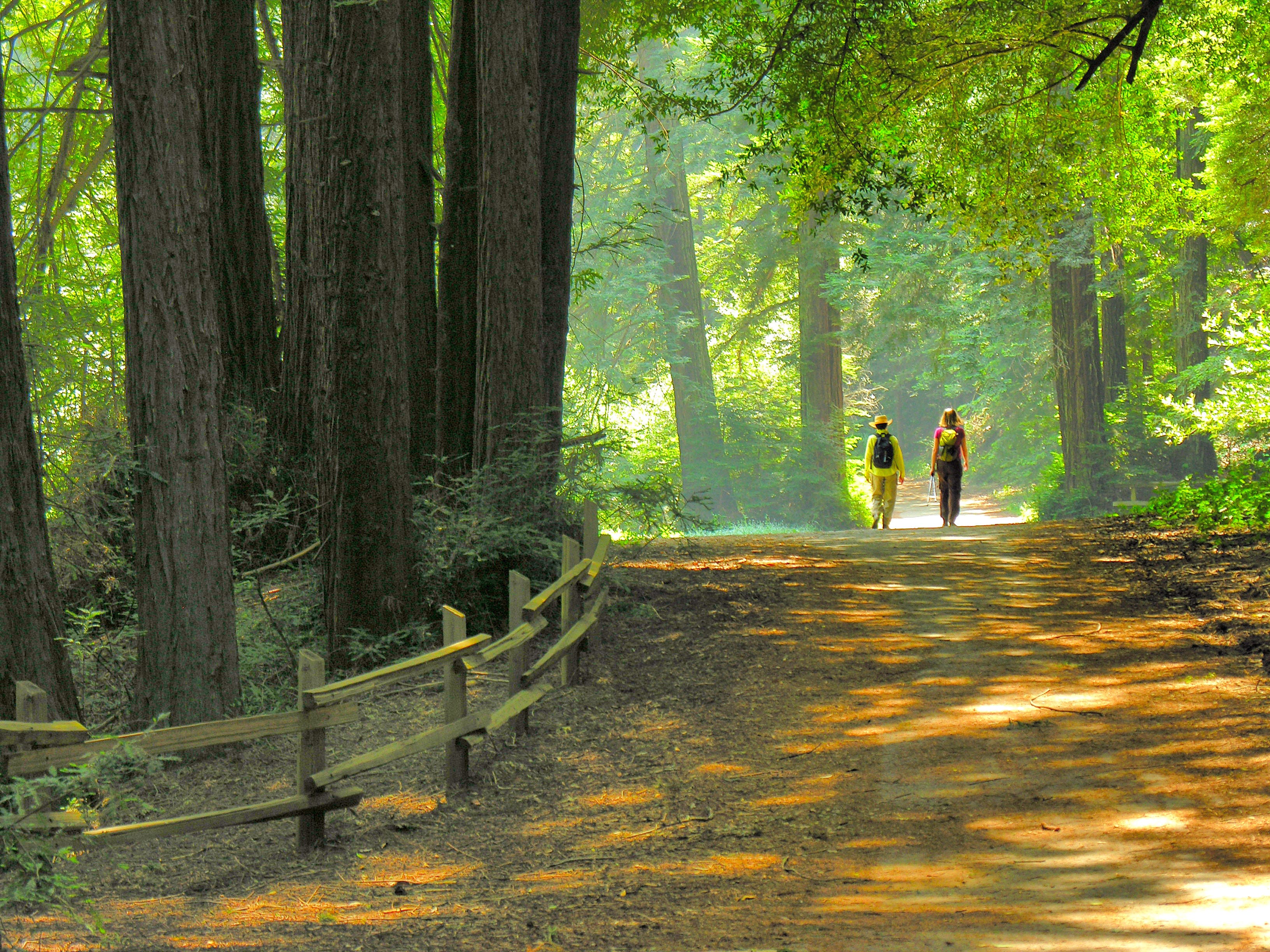
As for the Blossom Rock Trees, they had been turned into lumber by 1855, and their location and lore were soon lost. Then, in the 1980s, careful scientific sleuthing by East Bay Regional Parks District rangers located a fairy ring that, because of its enormous size and ridge-top location, gives the appearance of being descended from one of the trees. In 1986 the site became California Registered Historical Landmark 962. It lies a couple hundred yards west of the Roberts Regional Recreational Area parking lot off Skyline Blvd. The marker sits in the pleasant, cool, well-shaded Madrone Picnic Area, a lovely spot to enjoy lunch and let the kids have a romp among the redwoods.
And yet, a sadness hangs over this inviting place. What once was a magnificent, old-growth grove — with banks of redwood sorrel lapping the trees, sword ferns spiking toward the sunlight, and self-contained communities of plants and animals thriving in fern mats high up in the canopy — is now a much smaller, far less complex woodland lacking sorrel and fern mats. It will take the better part of a millennium before this patch of woods qualifies as old growth.
Something marvelous, something inestimable, has been lost to a mix of human need and equally human greed. The earth, and we too, are the poorer for it.