

Heading High with No Plan B
John Muir took long jaunts into the High Sierra, considering cold and hunger the price to pay for being there.

Early in learning the skills to backpack into remote mountains, I picked up a basic rule: always have a plan B. Think of it as a fallback in case something goes wrong, like critical gear that breaks way back there (it happened) or an unanticipated snowstorm that drops the temperature well below freezing and erases the trail (that happened as well). The mountains aren’t out to get you, but with no plan B, backcountry trekking poses unarguable risks.
So it came as a surprise to discover from a recently published manuscript that John Muir ventured into the Sierra crest on long saunters stunningly unprepared to handle what the alpine realm can serve up. He survived by clinging to the thinnest edge and gutting it out. For Muir that was the point.
The manuscript in question dates to 1876, two years after Muir made the first steps to leave behind his reclusive ways as a Yosemite hermit and embark on a public career as wilderness writer and advocate. It’s among the world’s largest collection of Muir materials — some of them still unscanned and unpublished — at the library of the University of the Pacific’s Holt-Atherton Special Collections and Archives and curated by Muir expert and archivist Mike Wurtz. He recently rediscovered the 1876 manuscript in the course of preparing a course he was teaching and gave me a heads-up when it was published as part of the online John Muir Papers collection.
The 1876 memoir fills an important gap in understanding Muir. His “early” memoirs, notably The Story of My Boyhood and Youth, A Thousand Mile Walk to the Gulf, and My First Summer in the Sierra, were in fact written when he was in his 70s and published just before and after his death. They reflect an elder’s reimagining of his younger self to fit the persona he had crafted over decades of an increasingly public life. The 1876 autobiography, by contrast, portrays the younger Muir when he was in fact younger — 38 to be exact.
The pages penciled in Muir’s hasty, now-faded script are difficult to decipher. Fortunately Linnie Marsh Wolfe, who wrote John of the Mountains (1938) and Son of the Wilderness (1945), transcribed them in the course of her research. What stands out in this raw, vivid first draft is the way Muir pitched himself into the wilderness with no plan B, as if vulnerable exposure to the wild were the purpose:
My mountaineering was not undertaken as mere sport or playday excursions, but with devout reverence and belief in Nature, eager to accept whatsoever the wild creedless Creator had to give me, believing in his eternal love, and willing to endure hunger and cold and weariness and isolation (from friends) that I might be true to myself.
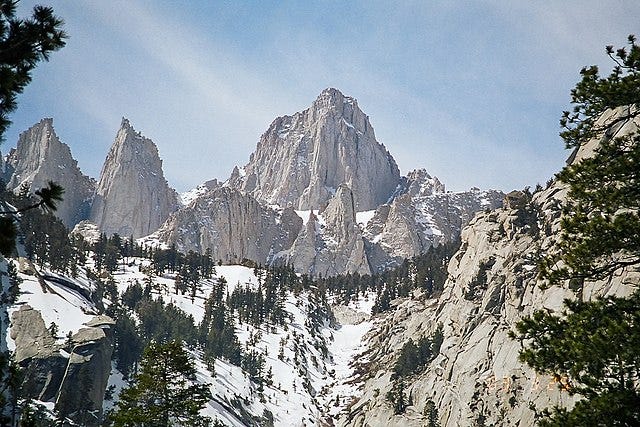
When Muir was exploring the forested reaches of the Sierra, largely below 9,000 feet, he packed what he needed onto an agile mustang pony: a pair of thick blankets, 8 or 10 pounds of bread or crackers, oatmeal, loose tea, and two large tin cans with handles for boiling and cooking. For bedding he laid out fir branches, artfully arranged and aromatic, then wrapped up in the blankets. But when Muir was headed above the timberline into the Sierra’s alpine reaches, the pony became a burden. So he stripped his kit to the barest necessities and carried it all himself: bread and crackers, oatmeal, sugar and tea, those tin cooking cans. He skipped the blankets, because they weighed altogether too much. Still the load was considerable:
I found that three weeks’ provisions loaded me heavily, so much of the travel being hard scrambling among rocks and chaparral. But notwithstanding the laboriousness of this method I like it better than any other; one feels so grandly independent.
It also meant that for those two- and three-week jaunts Muir was taking on the frigid alpine nights with no more cover than the clothes on his back and a small fire by his side:
Sleeping without blankets … [near] summits is trying. One is so thoroughly chilled by the frosty wind after the fire burns low, and nothing but unwavering love (of the mts.) will enable one to endure (its hardships) for any considerable time.
He slept in snatches, awakening again and again to shiver against the cold every time the fire burned down:
More wood is added and limb rubbing and warming is again carried on, then a third sleep, and so on all through the night, one’s sleep being thus broken into sections from an hour to half an hour in length or if wind extra strong and frosty every … 20 minutes but the night wears away at last and the white morning light floods the peaks. A wash in the icy brook or lake and a cup of hot tea and a can of porridge completes the revival. There is a huskiness in voice, and bones are sore and a certain degree of numbness and torpidity ... but [we] speedily thaw out, we stand straighter, eyes brighten and a change comes stealing on like that of the seasons from winter to spring, and I turn to gaze on the summits that I wish to climb.… I have thus during the past six years ascended the highest and most inaccessible peaks in the range and cut my way across the steepest and most crevassed of the glaciers.
Muir’s draw to the icy and the high was so powerful that he often overstayed his meager supply of food:
The first foodless day goes by without any noticeable effect other than a slight faintness (experienced in climbing steep places) but at night one is (I am) sure to dream of food and these bread dreams are a sure indication of serious hunger (real weakness).
Reluctantly, the famished Muir followed his bread dreams back to Yosemite Valley to resupply and catch up on hot food and warm sleep until it was time to head out and up yet again.
The dangers of this high-altitude pursuit, Muir assured his readers, were overblown. Bears usually ran the other way, tribal people were few and far between, rattlesnakes proved rare and retiring, and storms offered but cleansing spritzes from heaven:
Mountain dangers of every kind when met manfully inspire courage and in the end augment our enjoyments…. We hear much of the dangers of mountaineering, little of the dangers of staying at home. No icy rocky mountains that I ever saw seemed to me so dangerous as home.
In the Sierra Muir gained access to the realm of the Divine, a paradise once lost and now recovered:
Let on the beauty-force, and we are controlled by it. Let water upon mill wheels and they whirl. Let landscapes upon human souls and they move as by a like necessity. The feet of ducks are not more directly planned for water than human souls for landscapes…. all resounding and aglow with the glory of God, the enthusiastic beauty-loving Creator.
Cast out of Eden heads to Healdsburg, Calif.
On Thursday, Sept. 25, 7 p.m., I'll be in conversation with Denise Low (Lenape/Munsee) about John Muir and Native resilience as part of her Indigenous Voices series at THE 222, 222 Healdsburg Ave. This will be a ticketed event, and tickets can be ordered here.
Then it’s off to Mill Valley, Calif.
This Cast out of Eden talk on Wednesday, Oct. 8, 6:30 p.m., is sponsored by the Mill Valley Public Library, 375 Throckmorton Ave. Free and open to all; please register here.