
The Big, Bad Woods
Back in the day Americans destroyed wilderness as evil’s home turf. Trump and MAGA are still down with that.

In colonial America goodness ended where the trees began. That line formed the frontier, the place where civilization ceased and savagery held sway. Bears, wolves, and pumas on the animal side of the forest ledger, tribal murderers and white renegades on the human. Myth and folklore added a supernatural element to this mix by casting the woods as the abode of evil spirits, dangerous demons, and monstrous beings. The stories of Hansel and Gretel and of Little Red Riding Hood are but two of the popular tales taken from a line of Old World, forest-fearing legend that runs back at least as far as Gilgamesh’s epic battle with the forest demon Humbaba in the third millennium BCE.
Gilgamesh marked his triumph by felling the great cedars that had sheltered the monster and turning them into timber. Only such destruction answered the threat the trees posed. For civilization to advance, the forest had to be cut. Wood from the trees provided building materials and fuel for hearths and ovens even as the land was cleared for planting. Civilization advanced with the timber crew and the lumberman.
Wilderness was the flip side of paradise; everything Eden was, wilderness wasn’t. Forget the sweet-fruited trees, babbling brooks, lilting birdsong in thicket and meadow, sunny days, and pleasant nights of the garden. Wilderness was a dry realm of flesh-rending thorns where food was hardly to be found, the burning sun beat down, and nights turned bitter and cold. Then, too, the wild place teemed with dangerous beasts, from great cats hungry for human flesh to serpents whose bite meant agonizing death.
The Judeo-Christian tradition distinguished paradise from wilderness in its portrayal of good’s struggle against evil. In the Revised Standard version of the Bible, according to Roderick Nash’s Wilderness and the American Mind, the Hebrew scriptures use the word “wilderness” 245 times, and the Christian scriptures 45. In addition, there are several hundred uses of synonymous terms like “waste” or “desert” across both scriptures. Paradise was the realm of goodness, while wilderness, desert, and waste were evil’s hangouts. God himself walked in Eden, but Satan slithered into the garden disguised as a snake and used his wilderness guile to tempt Adam and Eve. Cast out of Eden for eating the fruit Satan offered and God had forbidden, then kept from slipping back in by an armed seraph, the first couple were condemned to wander the wilderness and scratch out a hard living.
When the Pilgrims landed in what is now Massachusetts, they carried this biblical dichotomy with them. It informed the way they saw their new home. They found themselves, according to contemporary chronicler William Bradford, in a “hideous and desolate wilderness.” No dry desert, to be sure, but a deep and gloomy forest that stretched unbroken beyond the farthest horizon. The endless trees housed wolves, pumas, black bears, and, worst of all, Native people who in paint and feathers worshiped forest demons and spirits. Salvation, the Pilgrims believed, lay in the command to dominate in Genesis 1:28:
God blessed them and said to them, “Be fruitful and increase in number; fill the earth and subdue it. Rule over the fish in the sea and the birds in the sky and over every living creature that moves on the ground.”
The Pilgrims battled not only for their own survival but also for the triumph of their God over Satan’s dark hosts. Felling trees, pulling and burning stumps, and clearing land for planting was holy work, a way of turning wilderness into a foretaste of paradise. The axe, the saw, and the plow advanced salvation as well as civilization.
That attitude helped form the American mentality well beyond the boundaries of the Pilgrim version of Protestantism. When Alexis de Tocqueville traveled from France in 1831 to see how American democracy was faring almost 60 years after the revolution, he reported:
In Europe people talk a great deal of the wilds of America, but the Americans themselves never think about them; they are insensible to the wonders of inanimate nature, and they may be said not to perceive the mighty forests that surround them till they fall beneath the hatchet. Their eyes are fixed upon another sight, the … march across these wilds, draining swamps, turning the course of rivers, peopling solitudes, and subduing nature.
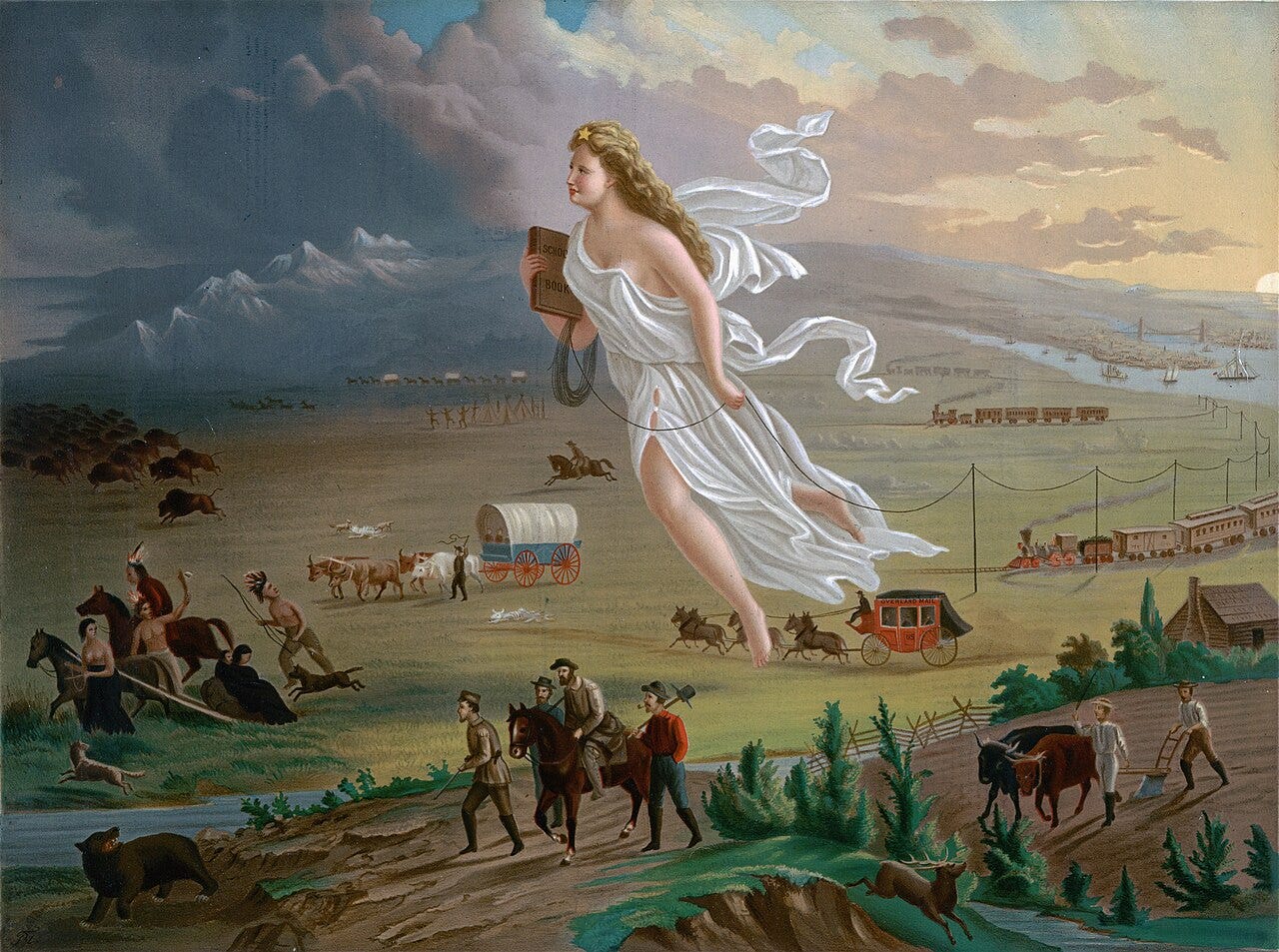
Tocqueville’s contemporary, President Andrew Jackson, asked rhetorically in his 1830 inaugural address:
What good man would prefer a country covered with forests and ranged by a few thousand savages to our extensive Republic, studded with cities, towns, and prosperous farms, embellished with all the improvements which art can devise or industry execute?
This frame of mind isn’t simply an artefact of the 19th century. It’s still with us, as recent moves by the Trump administration make clear.
At the end of last month, Trump revoked two executive orders – one from Richard Nixon, the other from Jimmy Carter – that restricted off-road vehicles like ATVs and dirt bikes on federal public lands, including national parks. A few days later a leaked draft memo reported by the New York Times detailed the administration’s plan to open millions of acres of national forest to off-roading. The affected areas include 5 million acres, primarily in Idaho and Montana, of wild landscapes the U.S. Forest Service has already recommended to Congress for inclusion in the federal wilderness system created under the 1964 Wilderness Act. Once the dirt bikers and ATVers have their way with those lands, they will no longer qualify as candidates for wilderness designation. Which, indeed, is the whole MAGA point.
Just as in the days of Pilgrims, Tocqueville, and Jackson, the urge to despoil and destroy continues. The wild forest remains both battlefield and casualty.
That amazing painting carries a lot of psychological freight, Freudian and other, an implicit violence? It could merit an essay of its own!