

The Serpent’s Garden
Last week it was coyotes among us. This week it’s rattlers. They’re connected.

This snake did take me by surprise. On a short hike into the northeastern corner of Mt. Diablo State Park, I’d stopped on the bank of an old livestock pond to apply sunscreen then started off on a narrow use trail around the water to a fire road. As I stepped out, the color and pattern of something in the shadows at the trail’s edge caught my eye. My first thought was a wayward cowpie spiraled like a poop emoji, but in the same thought I remembered that no steers have grazed this ground for years. I stopped to look again, more carefully. The still coil became a rattlesnake.
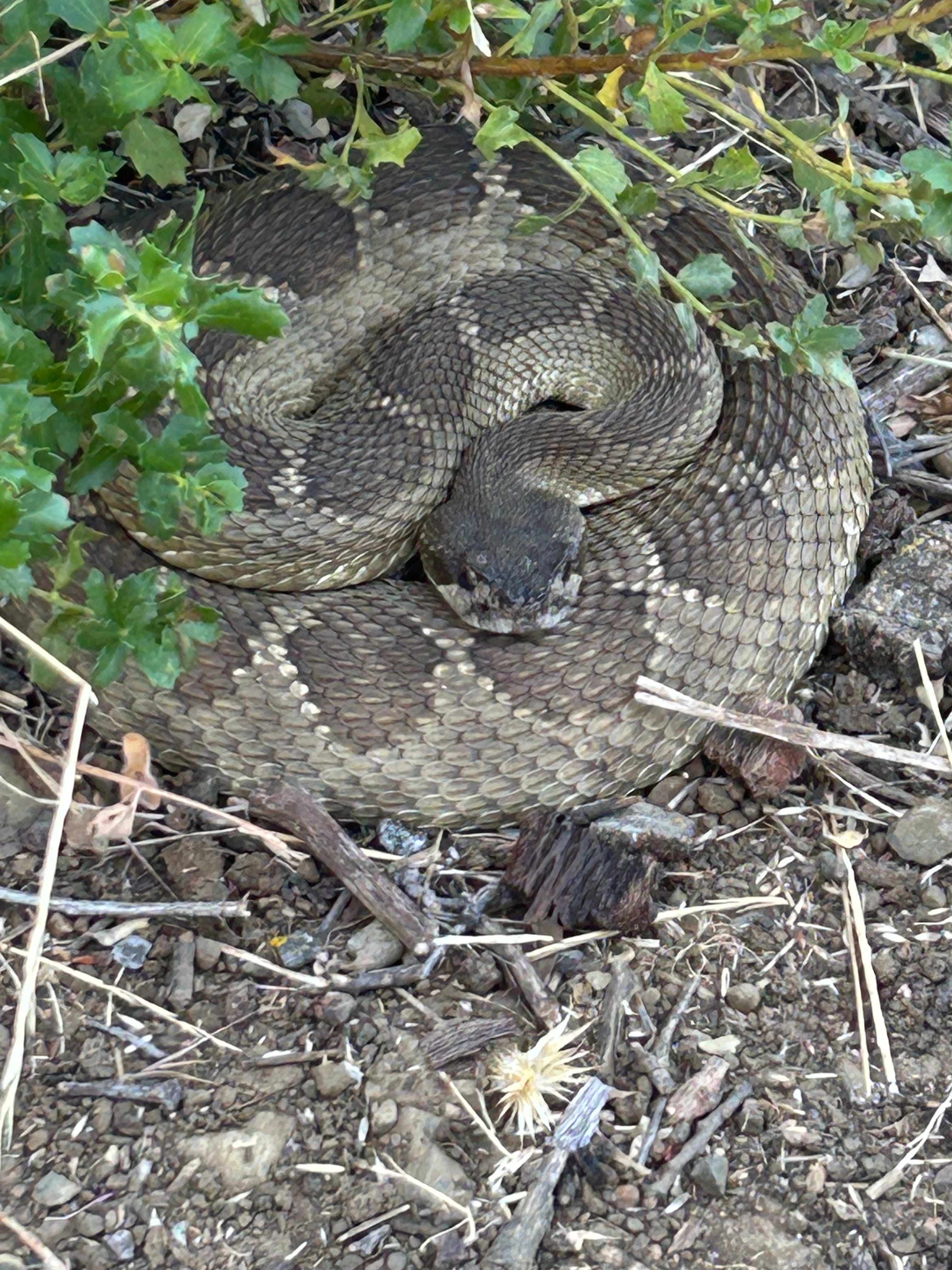
Although I was but a stride away, the snake remained motionless, neither flicking its tongue to sample my scent nor raising its head in threat. This rattler meant to escape notice altogether. Even when I crouched down as close as I dared to take the photo, it held utterly still, trusting in its camouflage. Deciding against stepping over or around the snake as an unnecessary provocation, I retreated a few feet and detoured onto another, wider path around the pond.
Rattlers, like coyotes, are critters I’ve grown used to encountering on the wild side. In the case of snakes, I’ve seen, or heard, dozens, sometimes close enough to startle and raise goosebumps. But only once in my experience has a rattlesnake caused harm, and that not to me but to my much-beloved Labrador, Ivy.
We were hiking in Marin County watershed lands when she bounded off, as hunting dogs do, into the chaparral. Suddenly she came flying out of the brush, landed with a look of canine consternation, and began licking her right forepaw. Only then did the snake rattle. Likely she stepped on or near it, and the frightened serpent struck without warning.
I knew enough dog first aid to forego the useless cut-and-suck heroics from cowboy movies. Instead I tied a tight ligature around Ivy’s foreleg above the paw then hoisted her across my shoulders in a firefighter’s carry. The goal was to keep the venom out of her trunk and as far from the heart as possible. It was about a mile walk back to my VW Beetle, then a semi-panicked drive across town to the emergency vet clinic. By the time I got there, Ivy had stretched out full length, her panting shallow and her eyes glassy as shock set it. She was one sick puppy.
Ivy spent two nights at the clinic after antivenin and antibiotics, and came home with her foreleg swollen nearly twice its normal size. In time it and she recovered. And we made many a hike together after that, now with a heightened awareness of what might be lying unseen in the shadows.
If I hadn’t been faced with the need to get Ivy to a vet as fast as possible, I might well have hunted that serpent down and killed it out of fear and revenge. In fact, though, the snake had done nothing wrong; it was simply defending its own life, as would any creature, benign or despised.
My research into John Muir for Cast out of Eden revealed his experience with rattlesnakes. It didn’t make it into the book, but it comes across as one of his most vulnerably human stories.
Muir’s first encounter occurred when he was crossing the San Joaquin Valley on his way to Yosemite in 1868. He stepped over the snake, which made no threat of attack, before he realized it was there, lying in the same still coil as my most recent rattler. He knew what he must do next:
At that time, thirty years ago, I imagined that rattlesnakes should be killed wherever found. I had no weapon of any sort, and on the smooth plain there was not a stick or a stone within miles; so I crushed him by jumping on him…. I felt degraded by the killing business, farther from heaven, and I made up my mind to try to be at least as fair and charitable as the snakes themselves, and to kill no more save in self-defense.
Self-defense did become the issue with a big rattler that took up uninvited residence in Muir’s little cabin in Yosemite Valley:
I did not want to kill him, but I had many visitors, some of them children, and oftentimes came in late at night; so judged he must die.
Muir killed that snake. But on his long saunters into the Sierra Nevada, he held to his live-and-let-live ethic, working around rattlers positioned inconveniently in or near the trail, once even even giving up a campsite where he found snakes in residence. Wishing to avoid an untoward confrontation when he got up in the cold night to add wood to the fire, he handed the place back to the rattlers and moved off to sleep somewhere else.
Muir had given up the common Euro-American sense of snakes as cursed creatures worthy of immediate death. The root of that feeling runs deep and old into the third book of Genesis, where God blasts the serpent — “more subtle than any beast of the field” — for tempting Eve to taste Eden’s forbidden fruit for herself and to seduce Adam into doing the same:
And the LORD God said unto the serpent, Because thou hast done this, thou art cursed above all cattle, and above every beast of the field; upon thy belly shalt thou go, and dust shalt thou eat all the days of thy life. And I will put enmity between thee and the woman, and between thy seed and her seed; it shall bruise thy head, and thou shalt bruise his heel.
Muir chose not to follow this ancient dictate, but rather to share with creatures the country that had been their home since well before humans ever came along. In this surrender to coexistence there lies a deep and worthy wisdom.
Muir and Rattlers
You’ll find John Muir’s take on rattlesnakes in his essay “Among the Animals of Yosemite” originally published in The Atlantic Monthly and included in his 1901 collection Our National Parks. It’s available online in the Sierra Club’s “John Muir Exhibit.”