
New Name, (Sorta) New Direction
The next book begins to take shape, and this essay series shifts focus.

Even the child me found solace in the woods. My birth family was chaotic, often dangerous, and the forest offered escape into the safety of the wild. A short bike ride delivered me to the edge of the experimental woodlands that Ohio State University maintained alongside the College of Agriculture’s experimental farms. There I could wander among hardwood thickets, hear thrushes and quail call as the sun settled, pick blackberries at summer’s end, watch crawdads in a small stream wave their claws, and catch sight of the occasional cottontail or raccoon. It was a Midwest paradise.
When I started out as a freelance writer and journalist back in the 1970s, I gravitated to stories about the wild: rattlesnakes, long-distance cross-country running, steelhead fishing, endangered whales and dolphins. After a number of magazine pieces, that last topic grew into my first book, So Remorseless a Havoc: Of Dolphins, Whales & Men.
Even though the book was put out by prestigious publisher Little, Brown and Company, it didn’t sell well enough to earn out the (modest) advance. That’s the reality of freelance writing: the money usually falls short. As a single parent of two growing boys, I needed a more reliable income. Advertising, media relations, and marketing communications paid much better, even as I kept touch with the publishing world through several collaborative book projects and a couple of ghostwrites. Still, my longing for the wild in writing as well as my backcountry wanderings remained. So, when I “retired,” with my sons through college and income a far less pressing issue, I returned to the wild book projects I wanted to write.
The first was The Modoc War: A Story of Genocide at the Dawn of America’s Gilded Age. What originally drew me to this story was the landscape where the war took place: the Lava Beds of remote Northeast California, a little-visited wild place wrapped in a fierce volcanic beauty and troubled by an unjust war. Next up was Cast out of Eden: The Untold Story of John Muir, Indigenous Peoples, and the American Wilderness. As a long-time solo backpacker, I considered alpine wild man and Sierra Club founder John Muir a hero and a paragon – until I realized how his unreconstructed racism denied tribal Americans a rightful place in the wild. Discerning that injustice led to the book.
Now I’m returning to my childhood fascination with, and salvation within, trees and forests. Specifically, the redwoods of California’s North Coast, which number among the planet’s most spectacular woodlands. They serve, too, as testimony to humankind’s contradictory ability both to destroy the planet out of greed and to save it from that selfsame destruction.
My working title is To See Such Trees: The Retreat of Greed and the Return of Awe Among California’s Redwoods. The title comes from a 1968 journal entry by Thomas Merton, the Catholic mystic and bestselling author of the classic memoir The Seven Storey Mountain. He was visiting California in search of a new monastic hermitage when he came upon the old-growth groves of Humboldt Redwoods State Park. The sight stirred Merton, a longtime forest lover, so deeply that he exclaimed, “Who can see such trees and bear to be away from them?”
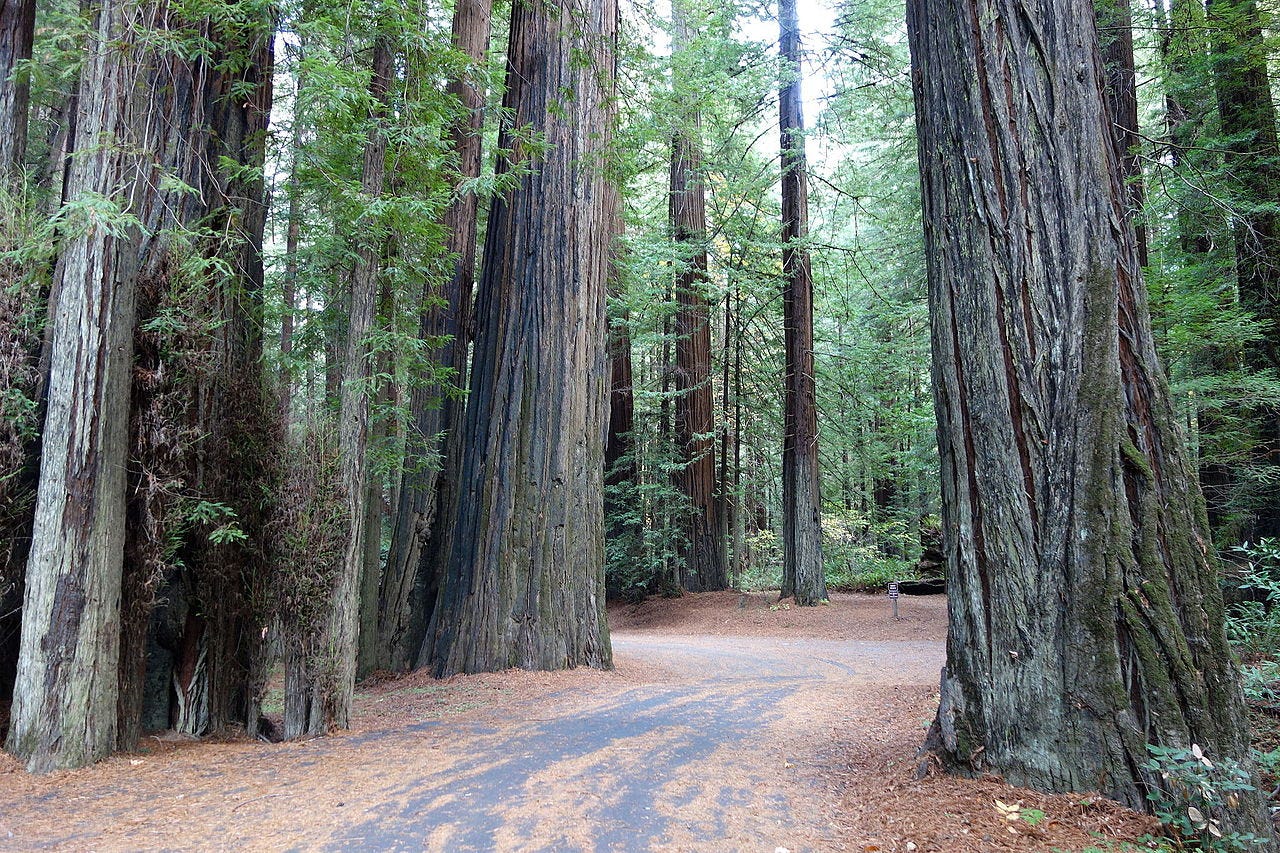
Such life-changing awe among giant trees hardly began with Merton. The tribal peoples of the North Coast grounded their worldview and life ways on awe, seeing the redwoods as the guardians of the forest and paying them respect as elders of the wider community of connected species. These days environmentalists, both inside and outside the tribes, are rediscovering that ancient awe.
The first section of To See Such Trees, “In the Beginning,” opens on the natural history of the redwood forest. It looks at the biology of the trees — how do they pump water more than 300 feet up into the crown? — their deep history as the remnants of a rainforest that once covered much of North America, and their communal reality connected by mycorrhizal root fungi (think Richard Powers’s novel The Overstory and Suzanne Simard’s memoir Finding the Mother Tree) and by complex, fern-based ecosystems in their canopies. Redwood groves are home to unique species of plants and animals, such as the Humboldt marten and the marbled murrelet. No wonder the North Coast tribes rarely felled redwoods. Rather, they used windfalls to fashion canoes and cut planks for their houses, incorporating these revered trees into treasured objects of daily life. The first American settlers had a much less beneficent encounter with redwoods, which they found to be gloomy obstacles to traveling across the landscape. The big trees just got in their hurried way.
The next section is “Greed.” It was gold, not timber, that drew those settlers to the North Coast. But as the gold played out, redwoods became a longer-term object of plunder for profit. Within just a few years, modest felling and milling operations started up, run mostly by Canadians from the Maritimes who were experienced in lumbering big trees. And, even as American settlers began to clear the redwood forests, they sought as well to clear the North Coast of the tribes. One massacre followed another throughout the 1850s and early 1860s; the taking of the trees and the killing of the tribes were inextricably intertwined.
The lumber industry transformed what had been the timeless guardians of the tribal forest into a merchantable commodity to be turned into grape stakes, roof shingles, railroad ties, and high-end heartwood lumber. Pure capitalism, of course, like the constant consolidation of the industry from dozens of small firms to a shrinking handful of larger and larger companies ever more distant from the forests. Headquarters moved from Eureka to San Francisco to, in some cases, Edinburgh and London. At the same time the technology to cut and mill the giant logs grew bigger and more advanced, from handsaws and oxcarts to early chainsaws and steam locomotives. These improvements meant that logging crews could cut ever more trees per year, widening the zone of destruction. Unlike the Sierra Nevada or the Cascades, held mostly in the national forest system, almost all North Coast timberlands remained in private hands through the lumber barons’ fraudulent use of the federal Timber and Stone Act and the Homestead Act. This progression led inevitably to Charles Hurwitz’s hostile, junk bond–fueled takeover of the Pacific Lumber Company in the 1980s. Driven to stay ahead of his crushing debt load, Hurwitz cut irreplaceable old-growth trees as fast as possible to turn them into quick money. The capitalist paradigm of extraction had reached its destructive apogee.
The third section, “Hope and Awe,” starts with the 1917 visit of three white supremacists and eugenics advocates — including Madison Grant, author of The Passing of the Great Race, the book Adolf Hitler called his “bible” — to the old-growth groves along the Eel River, the same trees that would later move Thomas Merton to ecstasy. The grandeur and antiquity of the redwoods, and the threat posed to them by rapacious clearcutting, moved Grant and his two friends to found the Save the Redwoods League. The three came from the moneyed patrician class of men’s clubs and Ivy League universities, so they followed a strategy of persuading fellow elites to buy old-growth groves and donate them to the League, which deeded the lands over to the state as parks. Such was the genesis of Humboldt Redwoods State Park, the first major North Coast reserve, in the early 1920s, the very place that gave Merton his mystical moment.
Not that this new movement stopped the clearcutting. The mounting collision of lumber companies and preservationists led to the Redwood Wars. Extending from the late 1970s into the 1990s, the struggle involved both legal battles in court and protest actions in woods and groves. What finally stopped the timber companies was awe, that feeling of cosmic grandeur that swept up Merton, Grant, and the tribes. The preservationists brought awe to the fore, not simply as a tactic but as a personal emotion that propelled them to act toward changing the future for the better — which is the very essence of hope.
Three significant figures encapsulate this struggle: Judi Bari, a labor organizer who was badly wounded in a car bombing that may have been the work of the FBI; Greg King, a journalist and an inventor of the tree-sitting tactic that stymied logging crews; and Julia Butterfly Hill, whose more than two years living in the top of the redwood she named Luna signaled the end of Hurwitz’s robber-baron rapacity. For these three, the redwood forest was a community of being, one they felt as deep within themselves as their own heartbeats.
The book will close on the current state of redwood affairs. Less than 5% of the old-growth trees still stand, yet that remnant is largely safe from human exploitation, a reminder that awe can bend the arc. The tribes of the North Coast are bringing back their cultural awareness of forest, land, and water in such actions as the successful campaign to remove the Klamath River dams and a major forest restoration effort by the Yurok Tribe. And there is Redwoods Rising, a project of Save the Redwoods League, which aims to restore logged North Coast landscapes by working with local communities and tribes and offering skilled employment for former loggers — all steps in the direction of a hopeful future.
So, as of next week, this CAST OUT OF EDEN Substack will go by the new name of TO SEE SUCH TREES. And if you’d like to comment on the book idea and share your own take on it, please do so here. Your feedback is most welcome.
50% off on my Univ. of Nebraska Press books and thousands more titles
Summer means reading at the beach or in the woods, and good reading begins at the Univ. of Nebraska Press and its Bison Books (publisher of The Modoc War and Cast out of Eden), Backwaters Press, and Potomac Books imprints. Browse the wide range of fiction and nonfiction on sale, then enter code 26SUMM26 in the discount field of your shopping cart.
Wonderful! I can't wait to see the book finished! In 1980, as a fairly young man, I visited many of the places you mention in your "preview" of the book.